Sourcing mesh fabric can feel overwhelming. You need the right quality at the right price, but the global market is vast and confusing. Making the wrong choice can stall your entire project.
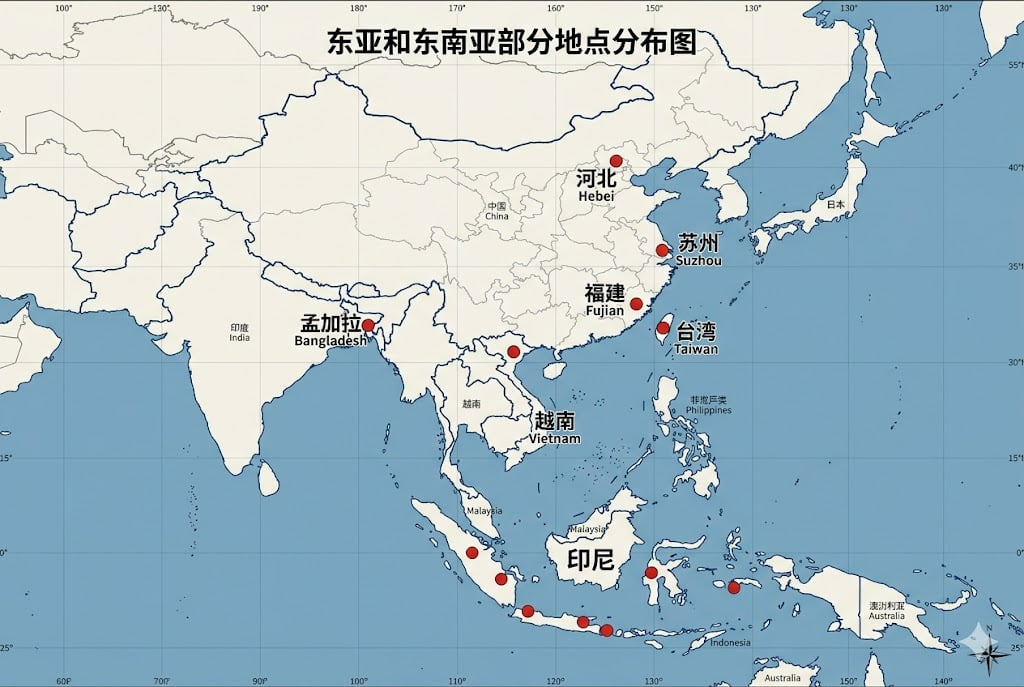
Choosing the right mesh fabric supplier means comparing key regions. China, especially the Fujian province, offers an excellent balance of quality, innovation, and cost. Taiwan leads in high-tech development but is more expensive, while other Asian countries often have higher costs and serve local markets.
This decision is more than just a line item on a budget; it impacts your final product's quality and your business's reputation. But how do these regional differences really affect your bottom line and your search for a reliable partner? Let's break down the major players to give you a clearer picture and help you make an informed choice.
Why Does China Remain a Top Choice for Mesh Fabric Sourcing?
You need a reliable supplier, but the sheer number of options in China can be daunting. It is hard to know which region, or which factory, to trust with your business.
China remains a top choice because its manufacturing hubs are highly specialized. Fujian offers a strong balance of quality and R&D. Suzhou focuses on high-volume orders. Hebei provides the lowest prices, but with a noticeable trade-off in quality. This diversity gives you powerful options.
Most of the mesh fabric you see today is made using a process called [warp knitting](https://www.maruyasu-fil.com/knit-magazine/2631)[^1]. It creates a stable, durable structure that is perfect for everything from shoe uppers to car seats. In China, we have several key regions that have mastered this technology, but each has its own personality. I've spent years navigating these markets, and the differences are significant.
A Look at China's Key Textile Hubs
Understanding these regional strengths is the first step to finding the right partner. It's not about finding the cheapest option, but the one that offers the best value for your specific product needs.
| Region | Primary Focus | Price Level | Quality Level | Best For |
|---|---|---|---|---|
| Fujian | R&D and Quality | Medium | High | Custom projects, high-performance applications |
| Suzhou | High Volume | Medium-Low | Standard | Large, standardized orders |
| Hebei | Low Cost | Low | Variable/Low | Price-sensitive products, non-critical items |
Factories here in Fujian, where my business is based, really focus on research, development, and quality. This is ideal for clients who need custom fabric with specific technical properties. We are not just making fabric; we are engineering solutions. In contrast, Suzhou is all about mass production. If you need a huge quantity of a standard fabric, they are incredibly efficient. Then there's Hebei. You will find the lowest prices there, but in my experience, this almost always comes at the expense of quality and consistency. For most of my international clients, that’s a risk they can’t afford to take.
Is Sourcing from Taiwan Worth the Higher Cost?
You want the most innovative fabrics on the market, but you have to watch your budget. Taiwanese suppliers offer cutting-edge products, but they come with a premium price tag. Is it right for you?
Sourcing from Taiwan can be worth the investment if your product demands the latest technology and your budget allows for it. Their factories are masters of new product development, especially for high-tech applications. However, their costs are significantly higher than in mainland China.
Taiwan has a strong reputation for innovation in textiles, and for good reason. They are often at the forefront of developing new yarns and knitting techniques. If you're creating a truly next-generation product, like a specialized medical device or elite athletic gear, a Taiwanese partner might be the only one who can create the material you need. Their R&D capabilities[^2] are impressive.
When to Consider a Taiwanese Supplier
The key is to weigh the unique function against the higher cost. For most commercial products, a more balanced approach often makes better business sense. I once had a client who was developing a new type of medical brace. They needed a fabric with a very specific compression and breathability profile that simply didn't exist on the market. We explored options, and a Taiwanese factory was able to develop it from scratch. The cost was nearly double what a similar, though less advanced, material from my factory would cost. For that client, the unique function was critical and justified the price. However, for 9 out of 10 clients I work with, who are making things like mattresses, office chairs, or pet beds, the advanced technology is overkill. They can get a high-quality, durable, and perfectly suitable fabric from a supplier like us in Fujian for a fraction of the cost.
What About Emerging Markets Like Vietnam, Indonesia, and Bangladesh?
You hear a lot about manufacturing shifting to countries like Vietnam or Indonesia. You might wonder if it is a cheaper or better option for sourcing mesh fabrics. Let's look at the facts.
While emerging markets like Vietnam and Indonesia are growing, they are not always the best choice for specialized textiles. Their factories are often large-scale, serve local demand, and have production costs about 15% higher than in China for mesh fabric.
The idea of diversifying the supply chain is appealing, and for simple cut-and-sew apparel, these countries can be very competitive. However, for technical textiles[^3] like 3D sandwich mesh, the story is different. The entire ecosystem matters. This includes the availability of specialized raw materials[^4], like high-quality polyester monofilament, and the technical expertise to run and maintain complex double-needle bar warp knitting[^1] machines.
The Reality of Sourcing Outside China
These newer manufacturing hubs are still developing this specialized infrastructure. As a result, their overall production costs for technical fabrics are often higher, not lower. I've heard from colleagues that the total cost ends up being around 15% more than what we can achieve in China. A few years ago, a contact of mine tried to source mesh from a large factory in Bangladesh to save money on a footwear project. They faced huge delays because the factory couldn't get the right yarn locally. The supply chain simply wasn't mature enough. They also found that these large factories were not interested in the level of customization or the smaller order quantities they needed. They ended up coming back to us in Fujian for their next order because we could provide the flexibility and reliability they needed. These factories are primarily set up to serve their large domestic markets, and they may not have the experience to meet the quality standards and logistical needs of international importers.
How Can You Find a Supplier That Balances Cost, Quality, and Customization?
You feel stuck between high-cost innovators in Taiwan and low-quality producers in Hebei. Finding a partner who delivers great quality and custom options at a fair price seems impossible. It is not.
The key is to partner with a manufacturer in a region known for balance, like Fujian, China. Look for suppliers who offer flexible order quantities, in-house quality control[^5], and deep customization capabilities[^6]. This ensures you get tailored, high-quality fabric without overpaying.
Finding the right supplier is about finding a true partner. It's someone who understands your goals and has the capability to help you achieve them. You don't have to choose between cheap and good. You just have to know what to look for. After years in this business, I've seen that the most successful partnerships are built on more than just price.
Your Supplier Checklist
When you are vetting potential suppliers, especially for a technical product like sandwich mesh fabric[^7], ask these specific questions. Their answers will tell you everything you need to know.
- Customization Power: Ask them directly: "Can you adjust the gram weight, thickness, and pattern for me?" A good partner will say yes. They should also be able to offer services like LOGO printing, anti-slip coatings, or edge wrapping. This is our specialty. We believe the fabric should be built for your product, not the other way around.
- Flexible Order Policy: Ask about their Minimum Order Quantity (MOQ). Many large factories won't even talk to you unless you're ordering a massive volume. We welcome smaller trial orders because we want to grow with our clients. We understand you need to test a new product before committing to a huge run.
- In-House Quality Control: Ask them to describe their quality inspection process. Do they have their own team, or do they outsource it? A dedicated, in-house team is a sign of a serious manufacturer. We control quality at every single step, from inspecting the yarn to checking the final packaged roll before it ships.
This is the advantage of working with a manufacturer in Fujian. We are in that sweet spot, combining technical skill with a flexible, client-focused approach.
Conclusion
Choosing the right mesh fabric supplier means matching your needs to a region's strengths. China, particularly Fujian, offers the best overall value by balancing cost, quality, and deep customization capabilities.
[^1]: Understand the warp knitting process and its significance in fabric manufacturing. [^2]: Discover how strong R&D capabilities can lead to innovative textile solutions. [^3]: Discover the applications and importance of technical textiles in various industries. [^4]: Learn about the importance of specialized raw materials for high-quality textiles. [^5]: Learn about effective quality control measures to ensure fabric excellence. [^6]: Learn about the various customization options available for tailored fabric solutions. [^7]: Discover the unique properties and uses of sandwich mesh fabric in various products.